Howdy, Stranger!
It looks like you're new here. If you want to get involved, click one of these buttons!
Categories
3. Elites and Environmental Antagonists

(BTW, Don't for get to do the Exercise: Environmental Organizations! You must add an environmental organization to the Environmental Resources Page ( https://docs.google.com/document/d/1T3TpbAwf9fSjyfwr6H1kc_85zS5txx_K0K2nbj3zePE/edit ). Tell us a little bit about the organization (2 sentences max on the google doc). Look them up on http://www.wrongkindofgreen.org to see criticisms of the organization before writing.)
Dowie, Mark. 1995. “3: Fix Becomes Folly” Losing Ground.
Dowie, Mark. 1995. “4: Antagonists” Losing Ground.
Bull, Benedicte. “2: Elites, classes and environmental governance” in Environmental Politics in Latin America by Benedicted Bull and Mariel Aguilar-Stoen (eds).
Watch: “Class Wars” from the Word People's Conference 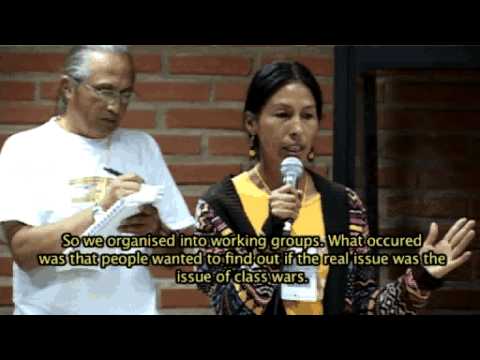
From an early age, we are subject to nationalistic indoctrination. As a result, we tend to think of the United States as somehow exceptional. As if corruption and elite control is something found in Third World countries but not here. Meanwhile when we look at the “developing” (if you believe in development) world we imagine that there’s something innately corrupt about the place, as if profiteering from US elites didn’t engender the corruption and prop up governments throughout Latin America that would allow US businesses to loot natural resources.
Dowie and Bull might be looking at different places (the United States, Latin America) but they are both looking at the role that elites play in both causing our environmental problems and shaping the “solutions.” The video is from a conference of activist in Bolivia—it very much captures the tension between “elite” environmentalism and the popular environmentalism of the poor.
What kinds of challenges to elites pose to environmentalists in the US and in Latin America? Are wealthy, well-funded environmental organizations a sort of elite class themselves? What role do elites have in shaping an environmental future? How do we get them to fulfill that role/constrain the damage they do?
Comments
Elites in the U.S. and Latin America pose unique problems per their contexts but share some similarities. For one, if we take elite to mean what Bull outlines in the 'structural/political economy approach', we look to the corporate executive or selfishly-motivated board member of an environmental organization. When reforms or policies arise on the governmental level that threatens their power, they can be wrestled with by these elites. Loopholes exploited by corporations with industrial lobbying are prime examples of how money talks and hides true intentions behind reforms. The abundance of capital, specifically monetary capital to fund the fighting of reforms or bolster their reputation reeks of corruption. Especially with supposedly 'no-strings-attached' donations to organizations to decide future trajectories. In a Foucault-style argument, the buying of prestige from environmentalists who need the funds from politicians and administrations allows the elites to control the media and information. In the U.S. this exact exchange happened with the 1980 Superfund Coalition and the environmentalist group, the Conservation Foundation.
Wealthy, well-funded environmental organizations have the opportunity to become an elite class if they are not already, due to the hierarchical structure within them of board members (who often come from sponsoring corporations). Hearing the remarks of the woman in the video from the World People's Conference, I would say that these organizations are already acting as elites in Latin America. Her worries about the 'lefts' entering their land and disregarding the role nature has in their culture is valid. With the merging of corporate interests and the increase of environmentalism in the 1990s as a concern for the U.S. voter, environmentalist organizations become politicized. I would go further to say that organizations, particularly U.S. environmentalist organizations that enter Latin America to help with litigation and legislation imposition are the biggest elites. Much like colonialism, the unsavory motives of whoever is in the pocket of the funding corporation who makes decisions on the organization board can hide behind the guise of environmentalism. This is a cynical viewpoint but the comparison of the power dynamics of the era of colonization seems to reemerge here under another name.
I have no concrete answer to how we can control how elites use their influence and resources to manage and not exploit the resources of a community. I think part of the difficulty is not being able to 'choose our elite' (as silly as that might sound), for example, if the funding of the organization coming into the Latin American rainforest is not funded by corporations then there is likely more checks and balances of power within their leadership. Yet the world does not work in this fashion. Furthermore, as Bull points out, the elites change and multiple elite groups can exist at the same time. I can only hope that collaboration with locals is taken up and that there is transparency throughout the decision-making process.
I believe that elites are elites whether they are business elites or environmental elites. The modifier put next to them does not change who they are. What makes them so was articulated very well by Bull. Due to their ability to affect practices and decisions and their ability to control resources, they wield the dual powers of being able to broker compromise and also amenable to it, because they ultimately control enough resources to insulate themselves and those they care about from the consequences of sweeping concessions. David Brower was quoted by Dowie saying "Let the people we pay to compromise—the legislature—do the compromising. ... Every time I compromise I lose." Elites are not beholden to voters actually affected by the issues they use as bargaining chips. Their homes will not be flooded by record breaking storms, their neighborhoods will not be polluted by powerful corporations. They have nothing themselves at stake, thus they have no real understanding of what is being lost in their concessions, what is being overlooked when they focus on charismatic but irrelevant animals rather than their fellow citizens. As Ansel Adams warned, environmental elitists are prone to getting important issues entangled in their own inflated egos, because they are elites and that is what is more personally important to them. They keep on with the same useless and failed tactics, because they are not the ones whose livelihoods and lives depend on finding innovative and effective ones. But most of all, they are maybe more like their adversaries than the popular members of their movements. They are, ultimately, elites wheeling and dealing with elites. There is no mystery to me as to why so many terrible compromises were made in the latter decades of the twentieth century by environmental elites and why they showed so little aggression or passion. They were fighting against their own kin, to whom they were always bound to be sympathetic. Thus they are obviously and woefully unfit to be leaders in the environmental movement.
I agree with @SpencerFier that an elite is an elite- a modifier in front of the word makes little difference. One type of challenge that elites pose that hasn’t really been mentioned, is the power to negatively affect environmental agendas even after legislation has been passed. One thing that really stuck with me from the readings was the concept of a "three bites of the apple strategy." The ability to subvert implementation of regulations is unjust. This also goes along with the section about conservative judges imputing their own bias and not necessarily upholding environmental laws. In my opinion, there should be more checks and balances for judges. It is interesting however, because there remains much outdated legislation still in our country and on one hand it makes a lot of sense for the courts ability to "second guess regulations."
I believe elites have a massive role in shaping the environmental future. I think that with the nature of our countries government, and most governments in general, the elites have almost all of the in sway in what happens. It's important to point out that all of the names mentioned in the chapters, including environmental leaders, do qualify as elites. While there's a scale, the environmental organization leaders have a lot more power than I do and they will play a role in shaping the environmental future. I think according to how elites decide they want it done, they could either positively or negatively affect our environmental future. Within the environmental movement, there seems to be very little large scale impactful grassroots networks. The course being taken currently, it feels like the most tangible means of change will come from a vast increase in grassroots work. To the point where the government can no longer ignore it. It feels like many of the big environmental movements have gotten themselves so stuck that changing their methods feels unrealistic. Though that’s not to say, if it was possible, that would be really, really impactful.
I wholeheartedly agree with your assessment. The constant stalemates in decision making between large environmental organizations (elites) may lead to harmful 'compromise' between business ventures and wildlife preservation within the precarious balance of ecotourism ventures. Look at Latin American countries that have significant ecotourism incentives in their national economy. When an elite like Marriott wants to build a seaside hotel, the government elites and their environmentalist consultants may see that specific regulation are in place to minimize the damage, but that only does so much. This is why ecotourism is scary to me because the elites are promoting it for commercial purposes. While some of the money generated may be invested into conservation efforts, the trade-off is inequitable. Not to mention the effect it has on the residents, as you pointed out above.
Furthermore, ecotourism vacations are marketed towards foreign elites wanting to have a better conscience about the impact of their visit. Now we have the different types of elites that Bull mentioned with a resource-based definition. Your point about compromise, in particular, made me think of a section of the Dowie reading when talking about Brower. "It works best when it comes from a synthesis of extremes" (Dowie 77). Dowie would argue that it is necessary to have radical preservationists included in the discussion as well as the openly pro-industrialism groups having discussions.
Your stance on the importance of grassroots movements is one I can get behind. In terms of the big environmental movements being 'stuck,' do you think that one of the aspects of these organizations involved that are restricting their change is overspecialization? The organizations introduced on the Resources Page the class put together, like the World Wildlife Fund state goals that are broad: 'limiting the impact of humans on the environment.' I think this is equally dangerous because, as a 'follower,' you do not know exactly where your funds are going unless donating to their specific fundraising projects. Meanwhile, 'Save Our Wild Salmon' is both species and location-specific, which alienates it from the larger pool of grassroots supporters who may have no connection with the area or species. Do you think change when the "government can no longer ignore it" happens more often within state and local governments? Does the press that comes with recognition from Washington only become effective occasionally because of the hoops that reformers have to jump through to make a political change? If only few 'battles' are won, do we need to focus on reforming the large environmentalist organizations as they are more likely to be heard on a national level or spark national reform?
I hadn't finished Dowie chapter four when I read this, but it ties into Bull even better than chapter three. Dowie is essentially applying Bull's thesis that elites are an impediment to more democratic and just governance. It was not even that big environmental groups intended to alienate the public and participate in a pitched battle. It was that they were elites and a fight waged with special access to resources and decisions was the only kind that they knew.
@caroline22 The three bites of the apple strategy was for me, as well, one of the most disheartening things I learned reading Dowie. Others made me righteously indignant, but the having no idea previously, and then learning that landmark legislation can be neutered by successive generations of legislators was simply depressing.
Yeah, thanks thats a great articulation of what I meant- I agree. Thats probably why I believe grassroots have so much more potential at this point- much more specific and in turn, I think they are so much more impactful. I will say though, Emily made a great point today when talking about environmental law. She was saying how it's so hugely beneficial, but not to all aspects of the movement. She said it's a piece of the puzzle which I think is so widely applicable. The big corporations and grassroots organizations all have their niche and it wouldn't be beneficial to completely replace one with the other. For me this is also applicable to discussions we had yesterday about the ELF. As destructive as it was, I think that it successfully had its niche in the movement.
I think we have yet to really see a wide spread change that occurs because the government can't ignore it. There's been small, important wins on this front, but no general trend ones that I can think of. I think it all starts small and local: if your local mayor can't ignore it, and this is a trend in the state, then the state governor can't either, and so on and so on. It's a snowball effect. I think for your last couple questions thats where the niche thing comes into play. They are probably most immediately more likely to be heard on a national level, but most logically to me would be to come at the government two ways-- the grassroots working your way up, and also the sort of infiltration through the large organizations. While one would probably work more successfully, and to be honest I'm not sure which would, I think theres great value in two different methods and applying two types of pressure on the government.
>
I believe an elite is an elite and well-funded environmental organizations are not an exception. That being said, I think organizations, like individuals, in the environmental movement from various backgrounds or statuses are necessary - this is a concept Emily talked about in class today. When this idea becomes counter productive to the movement itself is described by Dowie in Chapter 4 - Antagonists. To me a well-funded organization is not automatically corrupt/counter productive. That being said, there is a indisputable correlation between money and power which makes well-funded environmental organizations more powerful and often more influential which makes their responsibility exponentially more. This prompt makes me wonder if there is a point of no return when mainstream, well-funded organizations adversely impact the environment? Is internal reform within an organization possible and how?
I agree that change can happen when the government can no longer ignore the issue and that we have yet to see this but that just makes me wonder when the government can actually not ignore something. The Dakota access pipeline and water in Flint, Michigan were and still are large issues that were very loud (in the news a lot, protests, lots of support) but there have only been small wins in both of these issues (and some major losses). I agree that big environmental movements are stuck and that grassroots work initiating change is one of the only ways to achieve it. I think that using grassroots work to initiate change in environmental movements and corporations would be successful.
I think overspecialization of these organizations is hurting them but is also necessary. Without specialization to the degree of some companies the mission could get lost. I think there can be a balance of how specialized a company is based on the goal. In the salmon organization's case their goal is simply the salmon so making it broader, while they could get more support, would change their goal and require much more support.
I like that you brought up specialization. I agree, it is a complicated topic. On one hand, it can be a necessary tool in the way jargon is often necessary in explaining a specific topic. Specialization has also made the tools for change less accessible en masse. When someone asked Emily today about the role of lawyers in the environmental movement, she emphasized that people who studied law are critical players, not just people who are officially practicing law. I think this speaks to the world we live in which is overwhelmingly and increasingly characterized by specialization. The law, for example, is unreadable to the average citizen and the specialization of language has, in my opinion, hindered the momentum of most social and environmental justice movements. As a result, students of the law as well as practicing lawyers are crucial. With specialization as a defining feature of most aspects of America, the autonomy and authority of an average citizen is either actually undermined or, more insidiously, gives the illusion that the average citizen is unequipped to deal with problems outside of their physical, social, academic, etc niche.
I thought the discussion on elites in Bull’s work was a very interesting in reference to the environmental movement and the progress of society. I thought his discussion on their control of resources and the economy brings up a lot of tie ins to the progress of the environmental movement both in Latin America and North America. In the United States I think it’s interesting to analyze the well-funded environmental organizations as elites that in some cases prevent sustainable development of the country. I think this plays into the previous section of Dowie’s book where he discussed funding and the history of these organizations as being comprised of wealthy white men. When many of these organizations rely on funding from groups that degrade the environment they are no longer working towards their goal of environmental sustainability. There has been a shift and they are reliant on those they should want to stop. I think this plays into Bull’s analysis of the elite in that they both prevent the sustainable development of their country.
I think the role of elites in the future could go in both a positive or negative direction. There are and probably always will be powerful people that rely on the exploitation of resources and care little for the environmental movement, focusing solely on capital. I do however also think that there will be a wave of wealthy and powerful individuals that will put money and resources into solving environmental disasters. This can be seen in individuals like Bill Gate who have put lots of money into global health and environmental initiatives. The issue still remains that most people with power and resources are not involved in those movements. I think in order to hopefully get more elites interested in environmental movements we need to see interest in the general public from more grassroots organizations. If interest grows in the public is present individuals will begin to notice and possibly begin building an interest and passion for those movements themselves.
That relates to a concept Bull brings up in chapter 2. He provides three potential changes that he believes can occur with the elites: capitalistic elite dynamics, elite circulation, and state-elite distribution. The idea is that elite shifts will and do occur, the question is how. What's disheartening to me about it is that these shifts/changes he discusses are all very much so confined to a specific group of people: elites.
I agree with what you said about organizations, both grassroots and big corporations have a role to play in movement and can be important in producing change. I think grassroots organizations are responsible for putting the pressure on for what the people really want to see change and larger corporations need to be aware of those interests and add those to their own agenda. I think is important for bigger environmental organizations and other large companies that might not have any environmental interests. For example, Emily was talking about how providing Safeway with greener products is beneficial to the company because it's something many consumers appreciate. Therefore, I think all groups have a role to play in the movement, grassroots organizations need to be the voice that drive the change but other corporations play an important role as well.
I definitely agree that there will be a wave of wealthy and powerful individuals that will put money into solving environmental issues. This made me think of the Giving Pledge. Gates and Buffet started it and are among many other very wealthy people have pledged to do it but there are so many extremely wealthy people that still haven't. (Still annoyed Bezos hasn't but I love that his ex-wife did) I agree that grassroots organizations and movements will help more individuals gain interest but a lot of the elites are people and organizations that are only money driven sadly. I think that there will be many different waves of people starting to care, especially as our generation gets older and replace the elites.
Yeah I'm totally on the same page with you and Spencer with the three bites of apple strategy, that was also really striking for me. I also totally echo the sentiment of grassroots work. One thing I keep coming back to that Dowie highlighted really well is the idea of elites maintaining the power to set an agenda. To an extent, the issues being tackled, the amount of compromise is always held in the hands of the elite. This is particularly destructive coming from elites in the corporate world. More wealth means more money to spend in elections and more possibility to have people indebted to you for reelection, preventing progress environmentally. Beyond the corporate world however, I think agenda setting power is problematic in some of the environmental organizations. When organizations operated solely by elites pick and choose what's convenient to them, vast portions of the population go unheard. I think we still see some of the effects of this today, with wilderness or charismatic animals being prioritized over EJ concerns or people who are being deeply effected.
I think this discussion on specialization is really interesting and something I didn't originally think about. I think one could argue that in expanding the interest or goals of an organization to better suit the public interest causes the organization to become more "elite" because this will likley come with an increase in funding from bigger donors. I also like the tie in with what Emily mentioned about lawyers, and how having an understanding of the law is beneficial considering how inaccessible and confusing law can seem to the public. Our world has become increasingly specialized, possibly deterring some from making political progress. This speaks to importance of what Emily was saying about doing something that fits with your personality, maybe your interests might not seem super helpful to the movement initially but maybe that will give you a specialization that is needed.
Interesting point. This seems to lead back to the issue of elites. I agree that grassroots organizations should be responsible for pressuring larger organizations in that they're less corrupt or counter productive than mainstream organizations. That being said, grassroots ultimately have less resources to assert their agenda which does raise the question of how to effectively pressure a mainstream corporation with such a discrepancy in resources.
I see a lot of people talking about how elites will typically fall on the side of disregard for the environment and it is really grass roots movements that are the right tool for the job for something like this. However I think there is something to be said that in a society run by elites there needs to be some 'elites' on the other side to combat them. While I think grassroots movements have promoted change and sometimes succeed in their goal, in general an elite individual or group of elites will have a better chance of change. You guys think there could exist a world in which there are some 'benevolent elites' to combat those other elites that exploit people and the environment? Any one know of any? I guess the first one that comes to mind for me is Bill Gates, from my understanding he's used his vast wealth to help combat a number of social issues around the world.
I think these readings really just reminded me of the space that grassroots environmentalism can fill. I like to look at the role of elites more as amplifying the voices of people without their level of political power. From what Dowie describes, that was not the M.O. of the enviro elites in the Group of 10, especially keeping in mind making deals with oil and gas companies. I'm also looking back at our reading from 2 nights ago where Dowie talks about the environmental imagination. Elites have the power to realize a future that's comfortable for them, without really having to decide if it will livable for others. I think in order to mitigate damage, elites need to not be able to have a monopoly on decision making power in the first place, but also use their power to uplift grassroots or social movement demands rather than dictating what society needs.
I think this is for sure my favorite part of this whole discussion. I was getting a bit tired of seeing how the action of corporations and elite groups within environmental issues and policies seemed more justifiable and respected than those of more radical groups such as ELF. I for sure agree both have their niche, but I would also argue that the action of corporations in environmental policies have been way more damaging because it just perpetutated the system and never tried to go for the root of the problem. Nevertheless, ELF has clear ideals and action which go all the way into addressing the root of environmental problems: private property. I think that to say that the only useful thing these movements have done is to show the radicalism in the spectrum, would mean to take agency away from them and give it to the center or the green capitalists. Is like what Dowie was saying that if you do not have money they will think you are a crazy environmentalist. If you are not workng within capitalism, the movements are disregarded, and a lot of times disregrded by environmentalist themselves. It seems that they prefer to ally with capitalists first instead of environmentalists. If we are the same movement we should be in the same boat regardless of our "niche".
I really agree with what you both are saying about specialization. I wonder also if there's a level at which the specificity of each organization blurs the interconnected nature of environmental degradation. I totally think each issue is deserving of its own attention but at some level I feel like there's more systemic/ political forces which are constantly putting the environment after profit or consistently putting marginalized people at risk. Sometimes being able to look at the broader picture could shed light on the larger, more idealistic changes people can work towards
I think that the way that the environmental movement is currently structured is not conducive towards change, and that has to do with the overwhelming weight placed on the voices of the elite class. If these top 10 organizations were to open their doors, and their minds, to the issues facing the working class and specifically marginalized communities, then I believe there could be a balance where elite privilege can be used in a productive way. There will always be a need for environmental lawyers, and those with political power, but to have those agents represent a larger grassroots movement will provide the greater influence of a strong representative body. We need to restructure the approach to environmentalism in Washington, and highlight a need for a change in direction for the entire movement to focus on environmental injustices in urban areas, as well as continued issues of conservation.
I completely agree with you Charlotte that the environmental elites need to be using their political power to amplify the voices of a larger grassroots movement. I think that you make a very insightful connection to this idea of environmental imagination, and the fact that a single group of people can only imagine a future that fits their desires, but when talking about decisions that impact the lives of millions, they must draw opinions from a far wider and more diverse community. I think that this idea can also be tied to the Group of 10's decision not to ally with small farmers, ranchers, and loggers against big corporations. If they had seen these differing perspectives, and understood that together they could work towards a more inclusive wider goal, the movement would have been greatly strengthened.
I think that you bring up a really interesting point here, and I think that yes the elites still hold a very important role in creating political change. However, I think the current approach of elites to just continue working within the political system where they are at an insurmountable disadvantage will never be effective. I think that Bill Gates is an excellent example of an elite using their privilege to amplify the voices of less privileged people, and support grassroots movements. I believe that in order to change the political system there needs to be a social movement sparked by grassroots effort and supported by a large group of citizens, ideally with the political power of the elites furthering their message in Washington.
I think in an ideal world that sounds great but I think a lot of times elites will use their 'support' of a grassroots movement really as just a way to push forward their agenda. Do you think that there could exist a system in which an elite can support or fund a grassroots movement where they are actually in no position to push forth their individual goals?
Cara and Fiona were also having a discussion around overspecialization in another post which I feel like is worth reading for some of the points you are rising. When I look at grassroot organizations in Latin America, and moslty Uruguay, Argentina, and Ecuador, I struggle to find one that tries to particulary specialize in one environmental issue, nevertheless they do specialize in the region. In the Amazonas you have different organizations that address the different issues they go through, such as water pollution, acid rain, deforestation, etc. In the Patagonia the same happens. So for your question regarding State/local governments, I do think localized actions are usually more efficient, but the environment is hard to specialize, in fact I feel like doing it will be another attempt to commodify it, since usually environmental and social issues are interconnected. Nevertheless, we should always aim to change the large environmentalist organizations, and even small international ones, to work with and for these grassroot movements.
So a lot of you have brought up specialization and "good elites", specifically Bill Gates keeps coming up. I'd be a little hesitant to put the Gates Foundation forward as the ideal way of doing things (I think a much better example of a positive elite would be George Soros and the Soros foundation). I'm also going to disagree really strongly with the idea that Gates "amplifies the voices of the less privileged" because that's just not his foundation's profile.
The Gates Foundation is a very good example of specialization. They're led very much by numbers, moreso than community voices. On one hand, I think it's important that we have people operating at larger scales with technical knowledge--sometimes grassroots groups don't have that--but on the other when local voices are lost sometimes the organization doesn't see the forest for the trees ( @Julieta this one of the big lessons of Mitchell's Rule of Experts in our Technocracy unit last block ) . The Gates Foundation might see that their loan programs are fully "saturated" for example, but without hearing community members tell their stories about what they really need, they aren't going to be effective. The same goes for their medical programs. You need local voices to formulate more effective programs, not just metrics and assumed behaviors.
That's not to say that I hate the Gates Foundation-- I'm just saying their approach isn't as genuinely participatory as it could be. On the other hand you've got people like Leonardo di Caprio, Edward Norton, Brad Pitt being involved in enviro issues and Ashton Kutcher on human trafficking, and they represent an opposite extreme. Do they really know what they need to do in order to be effective with their dollars? They run a wide range of approaches and ideological proclivities, and I don't know of any grassroots organizations that have their ears. I love the documentaries that di Caprio does, and they play a role, but imagine what he could do if they were willing to slum it, let go of their own ideas, and allow a grassroots organization like Jesse's or Cynthia's to guide them?
At the end of "Two Worlds Collide" I saw di Caprio listed as an executive producer and my mind started to spin in a similar direction. I really started to wonder how much work these celebrities really do for the movement, and whether or not he should be listed first of the executive producers. This question of where their money and engagement would do the most good is also an interesting point. I wonder if these celebrities truly engage with the issues in their own community. As many reside in Los Angeles, I question their engagement with environmental justice issues in their own backyards and the housing crisis facing the state of California in general.